|
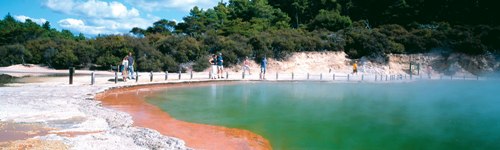 |
Wai-O-Tapu (Māori for “Sacred Waters”) is an active geothermal area just north of the Reporoa caldra in New Zealand's Taupo Volcanic Zone. The area has many hot springs noted for their colourful appearance, in addition to the Lady Knox Geyser. Prior to European occupation the area was the homeland of the Ngati Whaoa tribe who descended from those on the Arawa waka (canoe). Wai-O-Tapu is a marvel of Nature. Raw power, raw smells, raw scars over the land. Humans, or at least the Anglo- Saxons have come up with romantic names for some of the features It has names like Artist’s Palette, Champagne Pool, Oyster Pool and Primrose Terrace… The terrestrial hot spring is located about 30 km southeast of Rotorua and about 50 km northeast of Taupo. The name Champagne Pool is derived from the abundant efflux of carbon dioxide (CO2) similar to gas bubbles in a glass of bubbling Champagne. The hot spring was formed 900 years ago by a hydrothermal eruption , which makes it in geological terms a relatively young system. Its crater is around 65 m in diameter with a maximum depth of approximately 62 m and is filled with an estimated volume of 50,000 m3 of geothermal fluid . HydrochemistryThe deep geothermal water below Champagne Pool is of the order of 260°C [3] but water temperature within the pool is maintained at 73°C to 75°C by losing heat to the atmosphere. The pH of 5.5 is relatively constant due to buffering by the flux of CO2. Gases are mainly CO2, but to less extent nitrogen (N2), methane (CH4), hydrogen (H2), hydrogen sulfide (H2S) and traces of oxygen (O2) [4]. The siliceous geothermal fluid is oversaturated with metalloid compounds such as orpiment (As2S3) and stibnite (Sb2S3) which precipitate and form orange subaqueous deposits [5]. The colorful deposits are in sharp contrast to the grey-white silica sinter surrounding Champagne Pool. The wide range of colours in the Wai-o-Tapu thermal area is due to different mineral elements: As a Geothermal Area The water is so super heated that it absorbs the minerals out of the rocks through which it passes and conveys them to the surface as steam where they are ultimately absorbed into the ground. The wide range of colours are all natural and are due to different mineral elements. ActivityThere are numerous volcanic vents and geothermal fields in the zone, with Mount Ruapehu, Mount Ngauruhoe and White Island erupting most frequently. The zone's largest eruption since the arrival of humans was that of Mount Tarawera in 1886, which killed around 150 people. The Rotorua caldera has been dormant longer, producing its most recent giant eruption about 240,000 years ago. Ngakoro Lake translates as The Grandfather. The strange green water of the lake is caused by the presence of sulphur and ferrous salts. The lake was formed by a volcanic eruption more than 700 years ago and it is still geothermally active. The pale colour at the bottom is water entering the lake as it comes down a small waterfall from Frying Pan Flat. |
|

